Ask five web designers what a website costs and you’ll get five numbers and a lot of “it depends.” I run a local service business myself and built its site, and now I build them for other service businesses. Here’s the answer I’d give a plumber, a roofer or a salon owner across the counter.
How much does a small business website cost?
There are really three ways to get one, and they cost very different amounts.
- Do it yourself on a builder. The cheapest in cash. You pay a monthly plan, a domain and usually extra for things like booking or more pages. You also pay with your evenings, and that bill never stops.
- A freelancer or small studio. A one-time build price, then a small monthly fee for hosting and upkeep. This is where most service businesses should land.
- A full agency. The biggest quotes. Sometimes worth it for a company with a marketing team. For a two-truck HVAC shop or a cleaning company, usually more than you need.
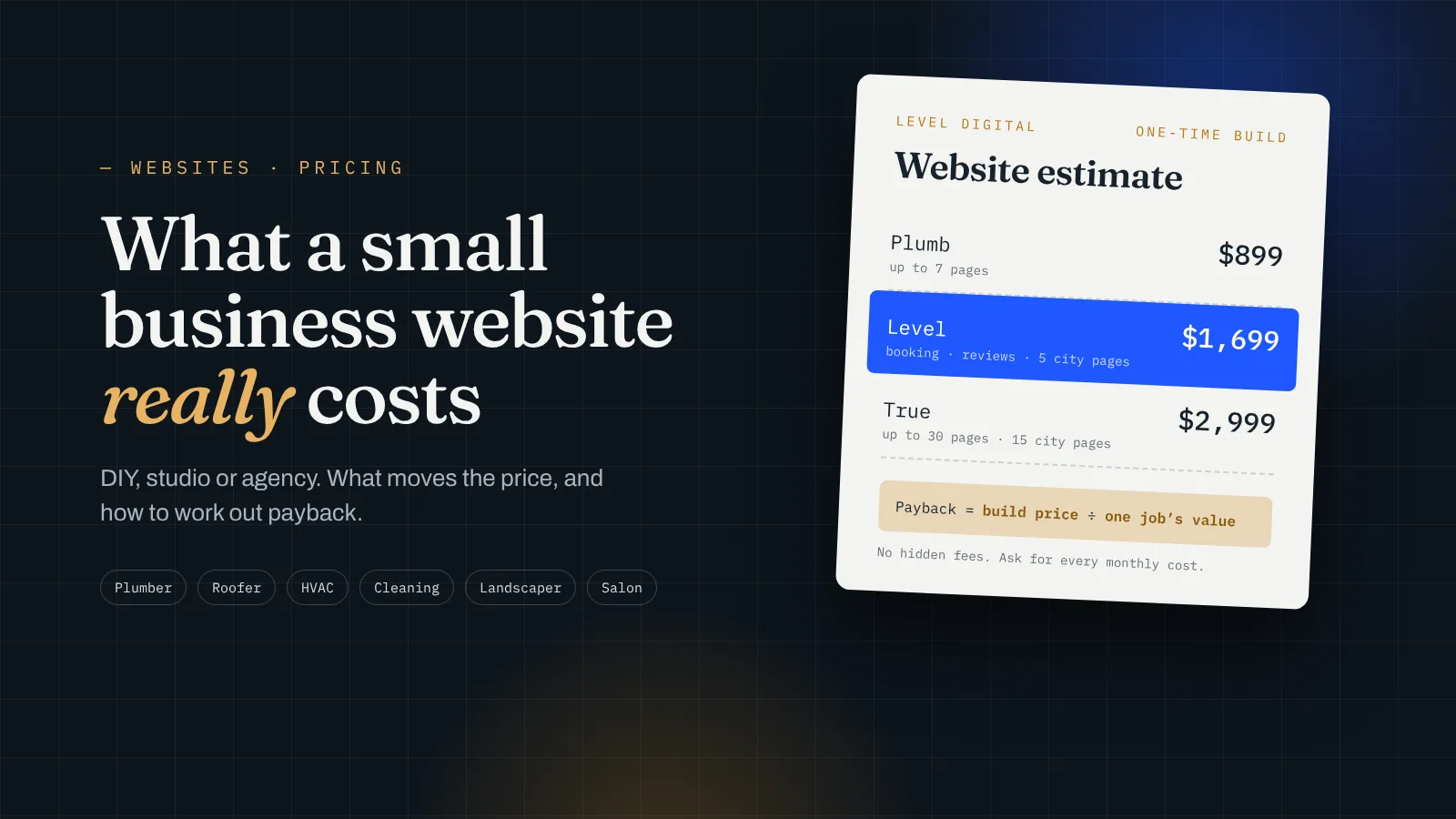
To give you a real number instead of a range: at Level Digital Studio our builds are $899, $1,699 and $2,999, one-time. Those are on our packages page for anyone to see. If someone won’t give you a price until after three calls, that tells you something too.
What actually makes one website cost more than another?
It’s not the colors or the font. It’s the work behind the pages. These are the things that move the price:
- Number of pages. A roofer who covers six towns wants a page for each one. Every real city page is written for that city, and that takes time.
- Booking. A contact form is easy. A booking button that drops jobs straight into Square, Jobber or Housecall Pro takes setup and testing.
- Who writes the words. If you hand over your copy, it’s cheaper. If the designer writes it from your real services, it costs more and usually reads better.
- Reviews, gallery and lead tracking. Pulling in your Google reviews, a photo gallery of real jobs, and call tracking so you know where leads come from.
- SEO setup. Page titles, descriptions, local business markup and a connected Google Business Profile. Cheap sites skip this, and it shows when nobody can find them.
So a one-page site for a solo electrician and a 15-page site for a landscaper covering five cities are not the same job, and they shouldn’t be the same price.
Is a cheap or DIY website good enough?
Sometimes, yes. And anything real beats nothing.
My first “website” was a Google Doc with a QR code. People thought it looked like a scam. I went five or six months like that before I built a real site, and it took me about a month to do it. After it went live, I had a customer in the first week and three more orders two weeks after that. Contacts have been steady since.
So if all you can do right now is a simple builder site, do it. But know what you’re trading. A cheap template usually means no city pages, no real booking, slow load times on a phone and SEO settings nobody touched. It looks like a website, but it doesn’t pull its weight. If yours is up and the phone isn’t ringing, I wrote about why in why your service business website isn’t getting calls.
What does a website cost after it’s built?
This is the part people forget to ask about. After launch you’ll pay for some or all of these:
- Domain. Your yourbusiness.com name, renewed every year. Make sure it’s registered in your name, not the designer’s.
- Hosting. Where the site lives. Builders roll it into the monthly plan.
- Branded email. you@yourbusiness.com looks a lot better on an estimate than a free email address.
- Upkeep. Backups, updates, small edits like a new service or a price change. Either you do it or you pay someone.
- SEO and ads, if you want more leads. The site is the storefront. SEO and ads are what bring people to it.
Ask any designer, me included, to list every monthly cost before you sign. No surprises six months in.
How do I know if a website is worth it for my business?
Work it backwards from one job. Ask yourself: if an average job is worth $X to me, how many jobs does the site need to bring in to pay for itself? Divide the build price by $X.
A hypothetical to show the math: say you run a cleaning company and an average job is $200. An $899 build is paid back by about five jobs (4.5, rounded up). Say you’re a plumber and an average call is worth $400. A $1,699 build is paid back by about five calls (4.25, rounded up). For a roofer, it might be one job.
Then think about how long that site sits there working. You pay for the build once. A good site keeps bringing in calls for years if it’s set up right and kept up.
And if you need leads faster than a website and SEO can bring them, that’s where ads come in. I went through how I split money between the two in SEO vs Google Ads for small business.
The short version
- DIY is cheapest in cash and most expensive in time. A small studio is where most service businesses should land.
- Price comes from pages, booking, writing, reviews and SEO setup, not from the design itself.
- A cheap site beats a Google Doc. It just won’t pull much weight on its own.
- Ask for every monthly cost after launch before you sign.
- Divide the build price by what one job is worth to you. That’s your payback.
Want a clear price for your own site?
This is what we do at Level Digital Studio for plumbers, roofers, HVAC companies, landscapers, cleaners, salons and every other kind of local service business. No hidden fees and no guessing. We build it, connect it, and hand it to you ready to take calls.
- Website builds. Plumb is $899 for a sharp site up to 7 pages. Level is $1,699 with booking integration (Square, Jobber or Housecall Pro), a Google reviews feed and five city pages. True is $2,999 for multiple cities and trades.
- No money up front? The Foundation bundle is $199 a month on a 12-month term, with no upfront build fee.
- Add-ons. Extra city pages at $99 each, branded email setup for $79, and a logo and brand kit from $350.
- SEO management. SEO plans are $299, $599 or $999 a month, month to month.
- Ads management. Google Ads from $299 a month plus ad spend, and Google Local Services Ads from $250 a month.
- Care plans. Keep Level is $49 a month and Keep Level+ is $99 a month, so you’re not the one fixing the site after a long day.
- Already have a site? A site audit is $149, and it’s credited toward a build if you go ahead.
I built all of this for my own service business first. If you’re not sure which one fits, the free site read below is the easiest place to start.
Questions business owners ask me
How much does a small business website cost?
It depends on who builds it. A DIY builder is cheapest in cash but costs your time every month. A small studio charges a one-time build plus a small monthly fee. Agencies quote the most. At Level Digital Studio, builds are $899, $1,699 or $2,999 one-time.
What makes a website cost more?
The number of pages (especially city pages), a booking integration, who writes the words, a reviews feed, gallery and lead tracking, and proper SEO setup. The design itself is a small part of the price.
What does a website cost after it is built?
A yearly domain renewal, hosting, branded email, upkeep like backups and edits, and SEO or ads if you want more leads. Ask for every monthly cost before you sign.
How do I know if a website is worth it?
Divide the build price by what one average job is worth to you. That is how many jobs it takes to pay the site back. For example, if a job is worth $200, an $899 build is paid back by about five jobs.
Want a real number for your website?
Tell me your trade, the towns you cover and the site you have now, or that you don’t have one yet. I’ll tell you straight what I’d build, what it would cost and what you can skip.
Get a free site read →