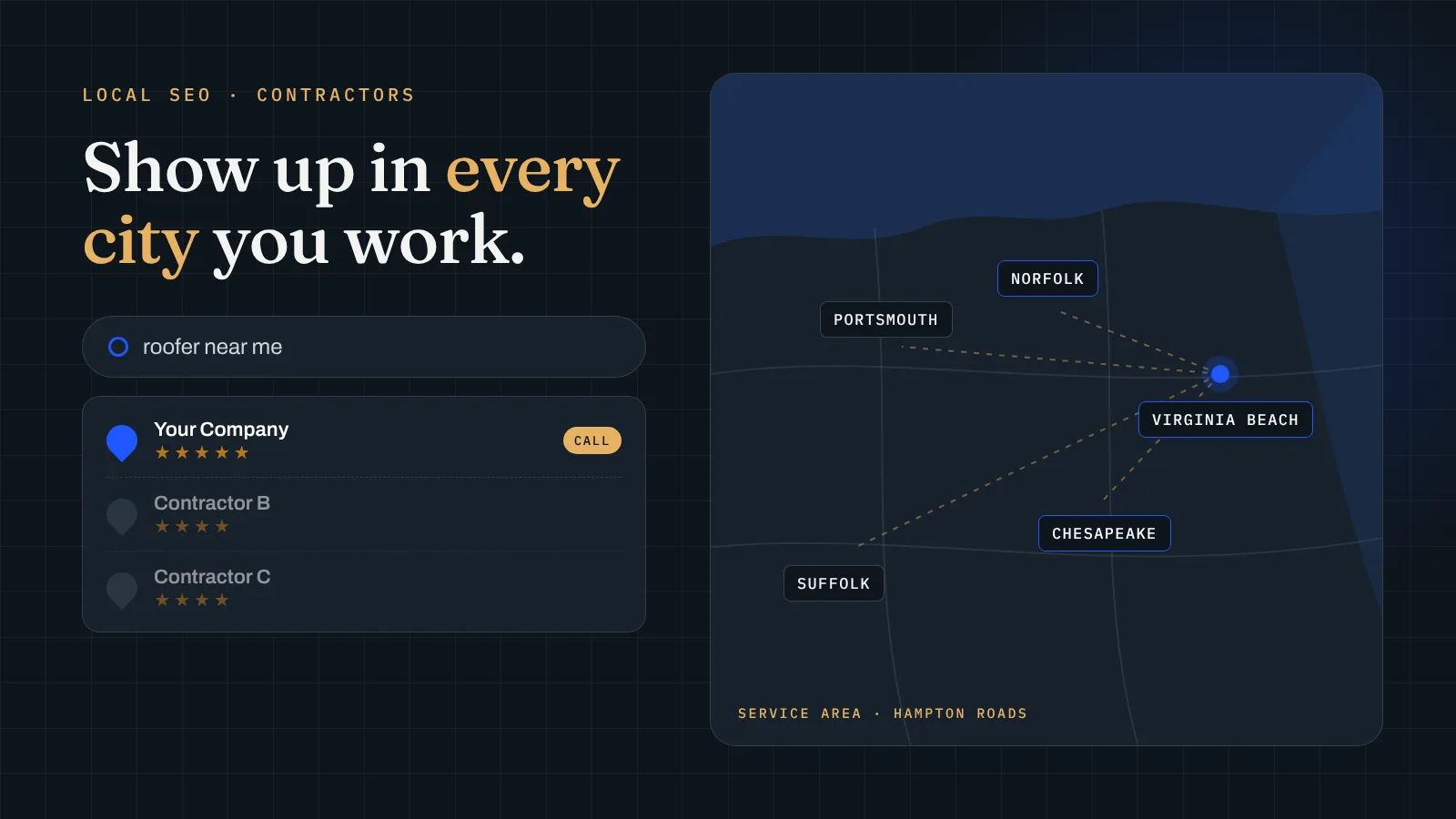
When someone in Kempsville searches “roofer near me,” Google shows three businesses on a map and then a list of websites. Local SEO is the work of getting into those spots and staying there. I run a local service business in Virginia Beach myself and built its site to show up across Hampton Roads, so this is how I’d go about it for a contractor here.
What does local SEO actually mean for a contractor in Virginia Beach?
It comes down to three things working together:
- Your Google Business Profile. That’s the listing that shows up on the map, with your reviews, photos, hours and a call button.
- Your website. Service pages and city pages that tell Google what you do and where you do it.
- Your name around the web. Reviews, and your business name, phone number and service area matching everywhere you’re listed.
Hampton Roads makes this a little different from a one-city market. Virginia Beach, Chesapeake, Norfolk, Portsmouth and Suffolk are all separate cities, and people search that way. A homeowner in Great Bridge types “plumber Chesapeake,” not “plumber Hampton Roads.” So if you work across the region, you need to show up for each city by name, not only the one on your business license.
How do I get into the map results without a storefront?
Most contractors work out of a truck or a home office. That’s fine. Google lets you set up as a service-area business: you verify your address, hide it from the public, and list the cities you cover.
After that, these are the things you control that move you up the map:
- The right primary category. “Roofing contractor,” “Plumber,” “HVAC contractor,” “Electrician.” Pick the one for the work you want most, then add secondary categories for the rest.
- Your services listed in plain words. “Water heater replacement,” not “comprehensive plumbing solutions.” Use the words people actually type.
- Reviews. A steady trickle of new ones, and you replying to each one.
- Real photos. Your jobs, your trucks, your crew. Not stock pictures.
- Staying active. Accurate hours, an update or two a month, and answering questions people leave on the profile.
The one thing you can’t control is distance. Google leans toward businesses close to the person searching. If you’re based in Chesapeake, the map will come easier there than in Sandbridge or Pungo. That’s where your website does the heavy lifting. If you haven’t set up the profile yet, start with how to get your business on Google Maps.
Do I need a separate page for each city I serve?
If you want to show up in that city, yes. One page per city you actually work in, and each one should be real: which services you do there, the neighborhoods you cover, photos of jobs in that area, and how fast you can usually get out there.
What doesn’t work is the same paragraph copied five times with the city name swapped. Google sees through that, and so do customers.
The site I built for my own business has 9 city and service-area pages, because that’s how my customers search. For a contractor based in Virginia Beach, I’d usually start with Virginia Beach, Chesapeake and Norfolk, then add Portsmouth and Suffolk, and Hampton or Newport News if you cross the water for work.
Service pages matter just as much. A roofer should have separate pages for roof replacement, roof repair, storm damage and gutters. An HVAC company needs AC repair, furnace repair, installs and maintenance plans. Each page says what the job is, what affects the price, and how to book. That way Google has a page to match “roof repair Virginia Beach” and another for “new roof Chesapeake.”
How long does local SEO take to start working?
Longer than most people want to hear. Some fixes, like the right category or a verified profile, can show up fairly quickly. Ranking a website for a competitive search like “roofing company Virginia Beach” takes months of steady work, not a couple of weeks. Anyone who promises page one by next month is guessing or lying.
If you need calls now, run ads while the SEO builds. I’ve done both for my own business. I spent about $1,000 a month on ads, and it brought back roughly $4,000 to $5,000 a month. It worked, but it stopped the day I stopped paying, and the leads that came from search were better. I wrote more about that in SEO vs Google Ads for a small business.
How I’d split it:
- You need jobs this month: about 70% of your budget on ads and 30% on SEO.
- You’re steady and building for next year: flip it, 70% SEO and 30% ads.
For contractors, Local Services Ads are worth a look too. Those are the listings at the very top of the page where you pay per lead instead of per click.
Should I do local SEO myself or hire someone?
You can do the basics yourself: set up the profile, pick categories, add photos and ask every happy customer for a review. If you have the time and you stick with it, that alone puts you ahead of a lot of contractors.
The website side is where most owners get stuck. Writing real city pages, keeping the site fast on a phone, setting up call tracking so you know which calls came from Google, and adding new pages every month. That’s where hiring help usually makes sense.
If you hire someone, ask them:
- What exactly will you do each month?
- Will I own the website, the domain and the Google profile?
- Do you report on calls and booked jobs, or just rankings?
- Is it month to month?
To see if it’s worth paying for, take what one average job leaves you after costs. Call it $X. Divide the monthly SEO fee by $X, and that’s how many extra jobs a month it needs to bring in. Here’s a made-up example: say you’re a roofer and an average repair leaves you $400. Our Growth plan is $799 a month. $799 ÷ $400 is about 2, so two extra repairs a month covers it. A single roof replacement would cover several months.
The short version
- Set up your Google Business Profile as a service-area business and list every city you cover.
- Pick the right primary category and list your services in plain words.
- Build one real page for each city you work in and each main service.
- Ask for reviews after every job and reply to all of them.
- Give it months, not weeks. Run ads in the meantime if you need calls now.
- If you hire help, keep ownership of everything and get reports on calls, not just rankings.
Want local SEO done for you?
This is what we do at Level Digital Studio for contractors, plumbers, HVAC companies, roofers, electricians, landscapers, cleaning companies and other local service businesses in Virginia Beach, Hampton Roads and beyond. We build it, connect it to your Google profile, and hand it to you ready to bring in calls. You own the site and the domain.
- SEO management. Our SEO plans run month to month with no setup fees. Starter is $299 a month for Google Business Profile optimization, 4 profile posts a month, citation cleanup and review request templates. Growth is $799 a month and adds a review generation system, 2 new pages a month and 2 local links a month. Authority is $1,299 a month.
- A site built to rank in each city. Level is $1,999 one-time with up to 15 pages, 5 city pages, booking integration, a Google reviews feed and call tracking. True is $3,999 for up to 30 pages and 15 city pages. Plumb is $899 for a focused site with Google Business Profile setup. Extra city pages are $149 each.
- No build fee up front. The Foundation bundle is $199 a month on a 12-month term: a Plumb-level site, hosting and care, and Google Business Profile management.
- Calls while SEO builds. Google Ads management is from $299 a month plus ad spend, and Local Services Ads management is from $250 a month.
- Care plans. Keep Level is $79 a month for hosting, backups, updates and an hour of edits. Keep Level+ is $99 a month and adds a quarterly SEO check-up. Cancel and keep everything.
- Not sure where you stand? A $149 site audit includes a Google Business Profile score and tells you what to fix first. It’s credited toward a build if you go ahead.
- Extras. Blog content is $199 a month, branded email setup is $79, and a logo and brand kit starts at $350.
Or start with the free site read below and I’ll tell you how I’d get you showing up in the cities you want.
Questions business owners ask me
What is local SEO for a contractor?
It is the work of showing up on the Google map and in search results for the towns you serve. It covers your Google Business Profile, your website’s service and city pages, and your reviews.
How long does local SEO take for a contractor?
Some profile fixes show up fairly quickly, but ranking a website for a competitive local search takes months of steady work. Run ads in the meantime if you need calls now.
Do I need a page for each Hampton Roads city I serve?
If you want to show up in that city, yes. Write one real page per city you work in, not the same text with the name swapped.
How much does local SEO cost for a contractor?
Our SEO plans are $299, $799 and $1,299 a month, month to month with no setup fees.
Want to know where you stand on the map?
Send me your trade, the cities you want work in and your current site, or “none yet.” I’ll tell you how you show up today, which city pages I’d build first, and which plan fits.
Get a free site read →